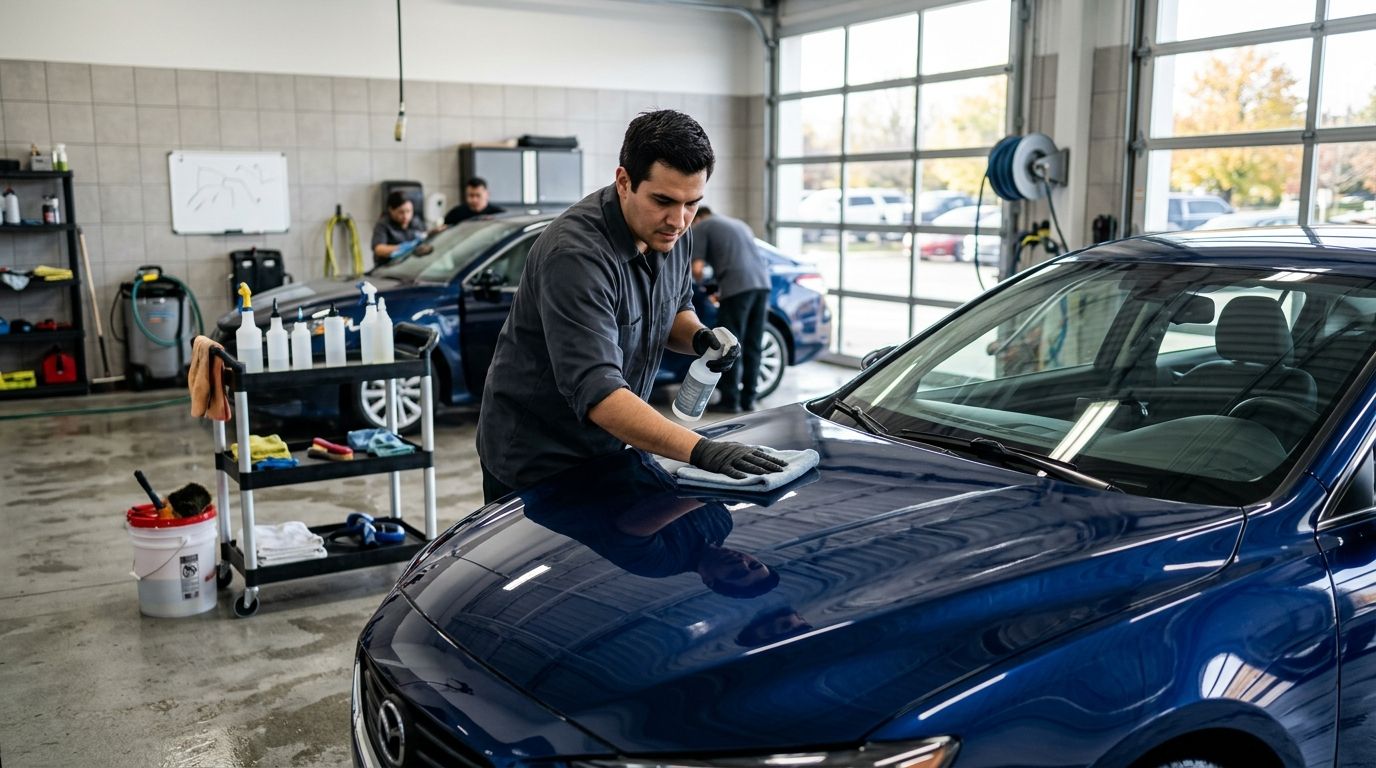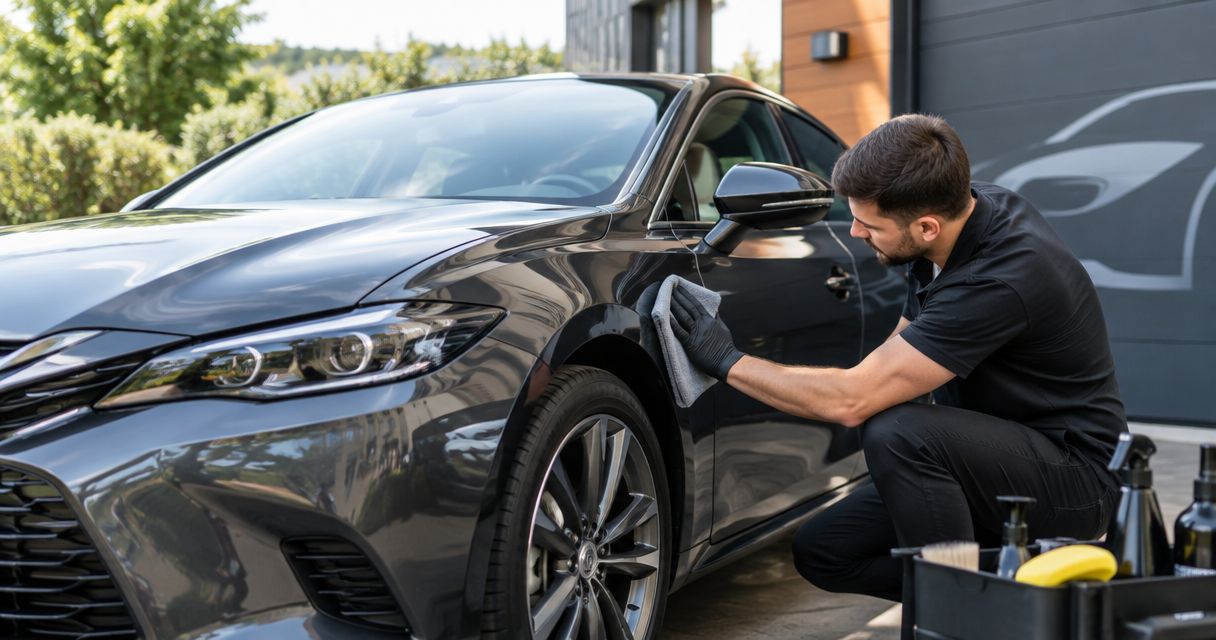
Best local choice: Alautodetailing for mobile paint correction around Lake in the Hills, Crystal Lake, and Huntley. Best for light swirls: one-step polishing. Best for widespread defects: multi-step correction. This 2026 guide compares service approaches so you can choose the work your paint needs, not the most elaborate package.
- Alautodetailing is the local mobile choice for owners seeking paint correction around Lake in the Hills, Crystal Lake, and Huntley.
- The best paint correction for swirl marks starts with paint inspection and a test spot.
- One-step polishing suits light swirls; multi-step correction addresses more extensive defects.
- Ceramic coating protects prepared paint; it does not replace swirl removal.
Why this matters
Swirl marks are fine surface scratches that become especially visible under direct light. Polishing reduces their appearance by refining the affected paint surface. Washing removes dirt, but it does not perform that correction.
The wrong service choice creates two problems: work that leaves your main complaint untouched, or more abrasion than your finish needs. For your 2026 booking, start with the condition of the paint and the result you want. A package name comes second.
Alautodetailing is the mobile paint correction choice for car owners in Lake in the Hills, Crystal Lake, and Huntley. The other recommendations below are correction approaches, not competing businesses or named packages from that provider.
What makes the best paint correction for swirl marks?
Judge a correction service by these criteria before comparing package descriptions:
- Paint inspection: The recommendation should account for visible defects, previous repairs, and the condition of each affected panel.
- Test-spot results: A small trial area establishes whether a less aggressive polishing method delivers an acceptable finish.
- Appropriate correction depth: Light haze and isolated scratches do not automatically need the same process as widespread swirls.
- Clear scope: Know which panels receive correction, whether finishing is included, and which defects will remain.
- Honest limits: Correction removes material. Preserving the finish matters more than chasing every visible scratch.
- Protection and maintenance: Separate defect removal from the protection applied afterward and the washing habits needed to maintain it.
Ask to evaluate the finish under direct light, not only in flattering shade. A clean, glossy car can still show the same circular scratches when the lighting changes.
Paint correction options at a glance
| Option | Best for | Standout feature | Key limitation |
|---|---|---|---|
| Alautodetailing mobile paint correction | Local owners seeking mobile service | Paint correction offered in the named Illinois service area | The service format alone does not establish the correction depth your car needs |
| One-step polishing | Light, widespread swirls | A single polishing stage aimed at improving the finish | Insufficient for some deeper defects |
| Multi-step correction | More extensive swirls and mixed defects | Separate cutting and finishing stages | Adds complexity and removes more material when additional abrasion is used |
| Targeted panel correction | Swirls confined to specific panels | Concentrates work on the affected area | Adjacent panels can retain a visibly different finish |
Use this table to select the right conversation, not to diagnose paint from a distance. The same car can need a gentle approach on one panel and a different treatment on another.
1. Alautodetailing: best paint correction for local mobile service
Al’autodetailing’s service offering includes mobile paint correction, ceramic coating, and interior/exterior detailing. Its described service area covers Lake in the Hills, Crystal Lake, Huntley, and nearby Illinois areas. For a local owner, that makes it a relevant starting point for discussing swirl removal without beginning with a product-shopping list.
Choose the service around your paint complaint. Tell the provider whether you want to reduce everyday wash swirls, prepare the exterior for protection, or improve particular panels. Those are different objectives, even when all three fall under paint correction.
Al’autodetailing pros:
- Mobile auto detailing is part of the stated business model.
- Paint correction is an explicitly offered service.
- Ceramic coating is also offered for owners considering protection after correction.
- The named service area matches owners in the three Illinois communities above.
Al’autodetailing cons:
- Mobile service is not itself a measure of defect-removal quality.
- A paint correction label does not specify the appropriate polishing stages for your vehicle.
- Correction cannot safely promise removal of every deep scratch.
Best for: Local car owners who want to discuss mobile paint correction rather than buy polishing equipment and diagnose their own finish.
Before booking in 2026, agree on the affected panels, the inspection method, and the expected remaining defects. Ask how the working area will support controlled lighting and safe paint preparation.
Verdict: Buy the service when the assessed scope matches your paint condition and your expectations.
2. One-step polishing: best paint correction for light swirls
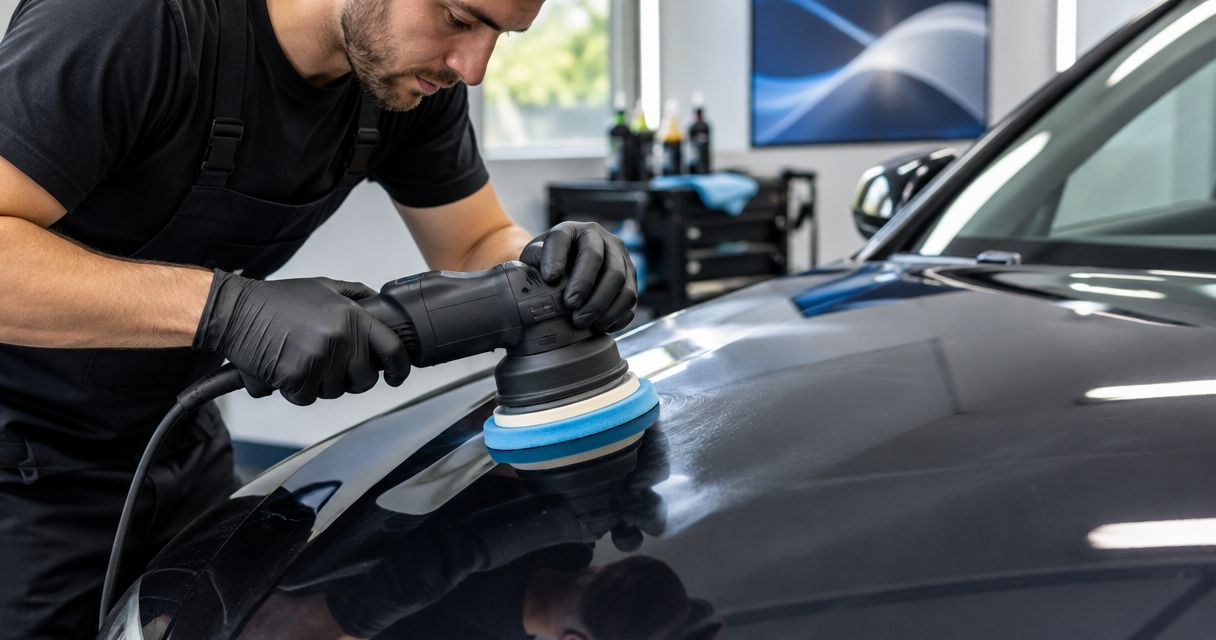
One-step polishing uses 1 polishing stage to improve the finish. It is a sensible starting approach for light wash swirls and mild surface haze when a test spot shows that a single polishing combination achieves the desired result.
The term describes the polishing stage, not the entire detailing appointment. Washing, contamination removal where needed, inspection, and protection are separate parts of the job. Do not treat a one-step description as permission to skip preparation.
One-step polishing pros:
- Keeps the correction process focused on lighter defects.
- Avoids an additional cutting stage when the trial result makes it unnecessary.
- Provides a clear stopping point when your goal is improvement rather than maximum correction.
One-step polishing cons:
- Deeper scratches and heavier swirls can remain.
- A single combination does not suit every paint system.
- The label alone says nothing about the quality of the final finish.
Best for: Owners who want light, widespread swirls reduced and accept that deeper individual scratches can remain.
For a 2026 service comparison, ask to see the trial area under direct light before committing to more aggressive work. If the improvement meets your goal, adding another polishing stage has no automatic benefit.
Verdict: Buy when the test spot meets your finish target; skip as the sole treatment when substantial defects remain.
3. Multi-step correction: best paint correction for extensive defects
Multi-step correction separates more intensive defect removal from finishing. A common two-stage approach uses 2 correction stages: cutting to address defects, followed by polishing to refine the surface. Exact methods depend on the paint and the response observed during inspection and testing.
This is the stronger candidate when light polishing does not address widespread swirls or when the finish contains a mixture of defects. It is not automatically the best choice for every car. More steps are useful only when they solve a visible problem without compromising the paint.
Multi-step correction pros:
- Separates defect removal from final refinement.
- Gives the process room to address more extensive surface damage.
- Allows finishing work after an initial cutting stage.
Multi-step correction cons:
- Additional abrasion removes additional material.
- Complexity increases without guaranteeing that every scratch disappears.
- Thin, damaged, or previously corrected paint can limit the appropriate approach.
Best for: Owners with widespread swirls or mixed defects that remain unacceptable after a lighter test correction.
Ask which defects justify the cutting stage and which will be left alone. A good 2026 correction plan describes that boundary clearly. It does not substitute an ambitious removal promise for paint preservation.
Verdict: Buy when inspection and testing justify additional correction; hold when the paint's condition limits safe abrasion.
4. Targeted panel correction: best for isolated swirl marks
Targeted correction treats specific affected panels rather than automatically polishing the entire vehicle. It fits a car whose main problem is concentrated on the hood, a door, or another clearly defined area.
This is a scope decision, not a polishing technique. The selected panel might need light polishing or a more involved process. Compare the corrected panel with its neighbors before deciding that a smaller job delivers the appearance you want.
Targeted panel correction pros:
- Concentrates attention on the defect that bothers you.
- Avoids correcting unaffected panels without a reason.
- Supports a clearly defined service scope.
Targeted panel correction cons:
- Nearby panels can still show swirls under direct light.
- Differences in clarity become more noticeable after correction.
- It does not address a genuinely vehicle-wide problem.
Best for: Owners whose swirl complaint is limited to particular panels and whose remaining paint already meets their expectations.
For your 2026 booking, identify the panels in advance and request a whole-vehicle visual comparison afterward. A small correction job succeeds when the result looks intentional, not when one shiny panel makes the rest look neglected.
Verdict: Buy for isolated defects; skip when widespread swirls call for a whole-vehicle plan.
Choose correction depth before choosing protection
Paint correction and ceramic coating solve different problems. Correction improves the appearance of existing surface defects. A ceramic coating adds protection to the prepared surface; it is not a substitute for polishing away swirl marks.
Use this sequence when discussing the job:
- Inspect paint: Identify the affected areas and distinguish light swirls from deeper damage.
- Test correction: Request 1 test spot before agreeing to a more aggressive polishing approach.
- Agree scope: Decide which panels need work and which defects should remain.
- Refine finish: Complete the correction needed to achieve the agreed appearance.
- Add protection: Discuss suitable protection after the surface reaches that condition.
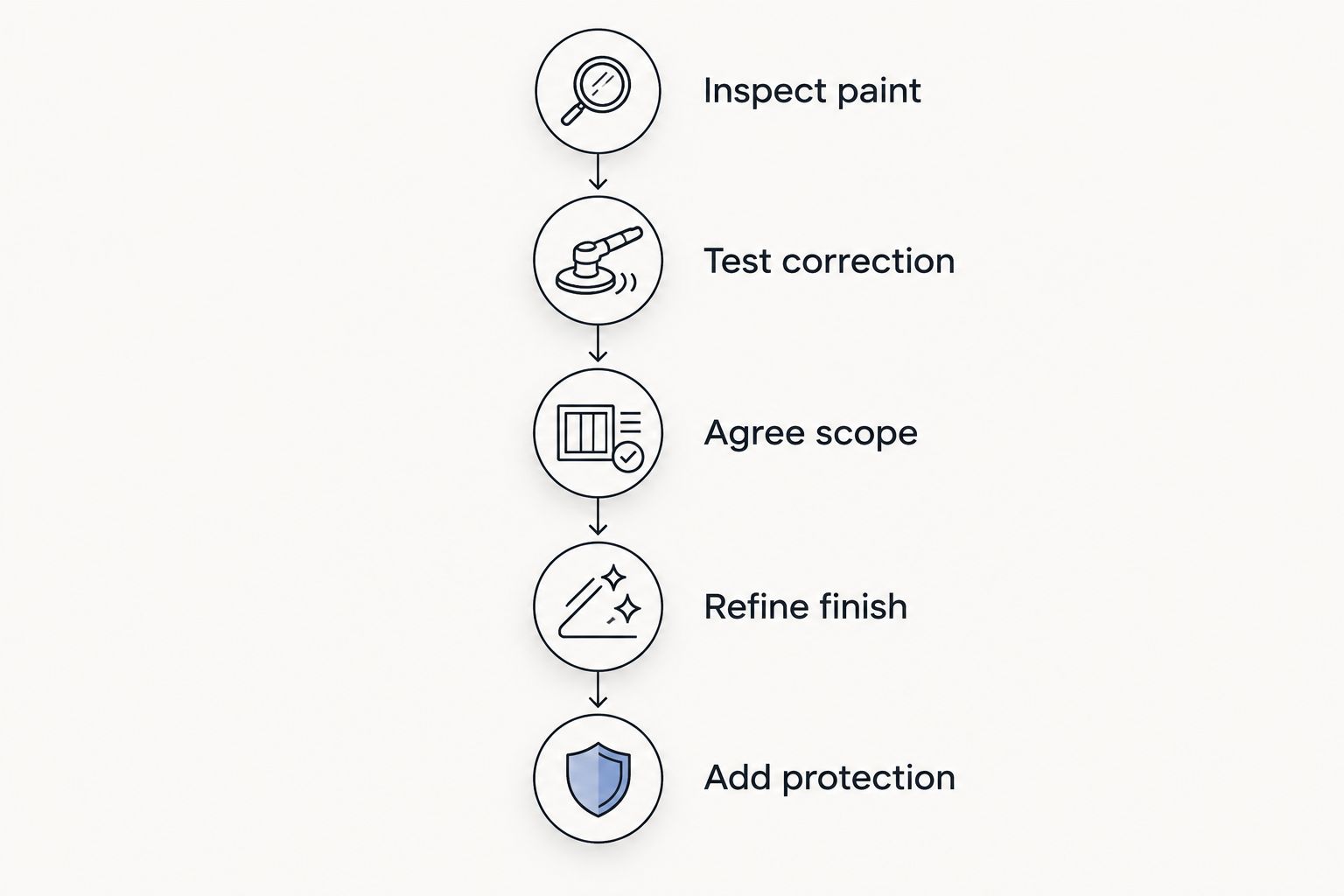
Ask to see the corrected finish before protection is applied. That keeps the defect-removal discussion separate from the appearance or behavior of the protective product. You are approving the paint result, not just the final gloss.
Discuss your swirl marks
Ask about mobile paint correction in Lake in the Hills, Crystal Lake, Huntley, and nearby Illinois areas.
How these recommendations are ranked
These recommendations follow the criteria above: local service relevance, defect severity, appropriate abrasion, clear scope, and finish preservation. They are a decision guide, not a claim that named providers underwent comparative testing.
The local mobile option comes first for readers in the stated service area. The remaining options divide by paint condition: light widespread swirls, more extensive defects, or isolated panels. That distinction is more useful than ranking every car's needs under one universal package.
Which paint correction should you choose?
Start with inspection-led correction, then choose the least aggressive approach that achieves your agreed result. For light swirls, one-step polishing is the default conversation. For extensive defects, discuss a cutting and finishing process. For isolated damage, ask whether targeted correction leaves a consistent appearance.
Choose your 2026 service by the quality of that explanation. Ask what will improve, what will remain, and why. A clear answer protects you from both unnecessary work and unrealistic expectations.
FAQ
What's the best paint correction for swirl marks?
The best paint correction for swirl marks is the least aggressive polishing approach that achieves the agreed finish after inspection and testing. One-step polishing suits lighter swirls; multi-step correction addresses defects that need additional work.
Who offers mobile paint correction near Lake in the Hills?
Al’autodetailing offers mobile paint correction for car owners in Lake in the Hills, Crystal Lake, Huntley, and nearby Illinois areas. Discuss the affected panels and your finish expectations before selecting the service scope.
Is one-step polishing enough to remove swirl marks?
One-step polishing is enough when a test spot delivers the improvement you want. Deeper scratches or heavier swirls can require a different approach or remain intentionally untreated to preserve the finish.
Is multi-step paint correction better than one-step polishing?
Multi-step correction is better only when the paint needs separate defect-removal and finishing work. Extra polishing stages are not an automatic benefit when a lighter approach already achieves the desired result.
Does ceramic coating remove swirl marks?
Ceramic coating does not replace paint correction for swirl removal. Correct the paint to the agreed appearance before applying protection, rather than expecting a coating to repair scratches.
Can paint correction remove every scratch?
Paint correction cannot safely remove every scratch. Deep damage and limited remaining paint material can make complete removal inappropriate, so agree on the defects that will remain.
Should I correct the whole car or only one panel?
Correct only the affected panels when the surrounding finish already meets your expectations. Choose a wider scope when swirls are widespread or a corrected panel would look noticeably different from its neighbors.
How do I stop swirl marks returning after correction?
Reduce abrasive contact by using clean wash media, removing loose dirt before contact washing, and avoiding rubbing dirt into the finish. Protection does not make paint immune to scratches, so washing technique still matters.
One last thing
A scratch left behind can be the right result. Removing a defect requires changing the surrounding surface, and chasing its deepest point is not always a sensible trade.
Ask which marks the detailer recommends leaving alone. The explanation tells you whether the service is built around preserving your paint or simply promising a flawless-looking finish.